
What Makes a High-Performance Fingertip Sensor?
A fingertip pressure sensor is a special type of tactile sensing device designed to measure the distribution and magnitude of pressure at the surface of a human or robotic finger. They differ from conventional force sensors; fingertip pressure sensors are built to detect subtle variations in touch, grip, direction, and other hand forces that occur during interaction with objects.
The electronic architecture of a fingertip pressure sensor is designed to register not only direct pressure on the surface but also subtle lateral forces that occur along the sides of the finger. This multidirectional sensitivity enables higher precision and a more natural replication of human touch in robotic applications
Fingertip Pressure Sensor Specifications: What the Market Needs
At Loomia, we've worked with engineering teams across robotics, prosthetics, and automotive to develop soft fingertip sensors. Here's what we've learned about what actually matters in the real world.
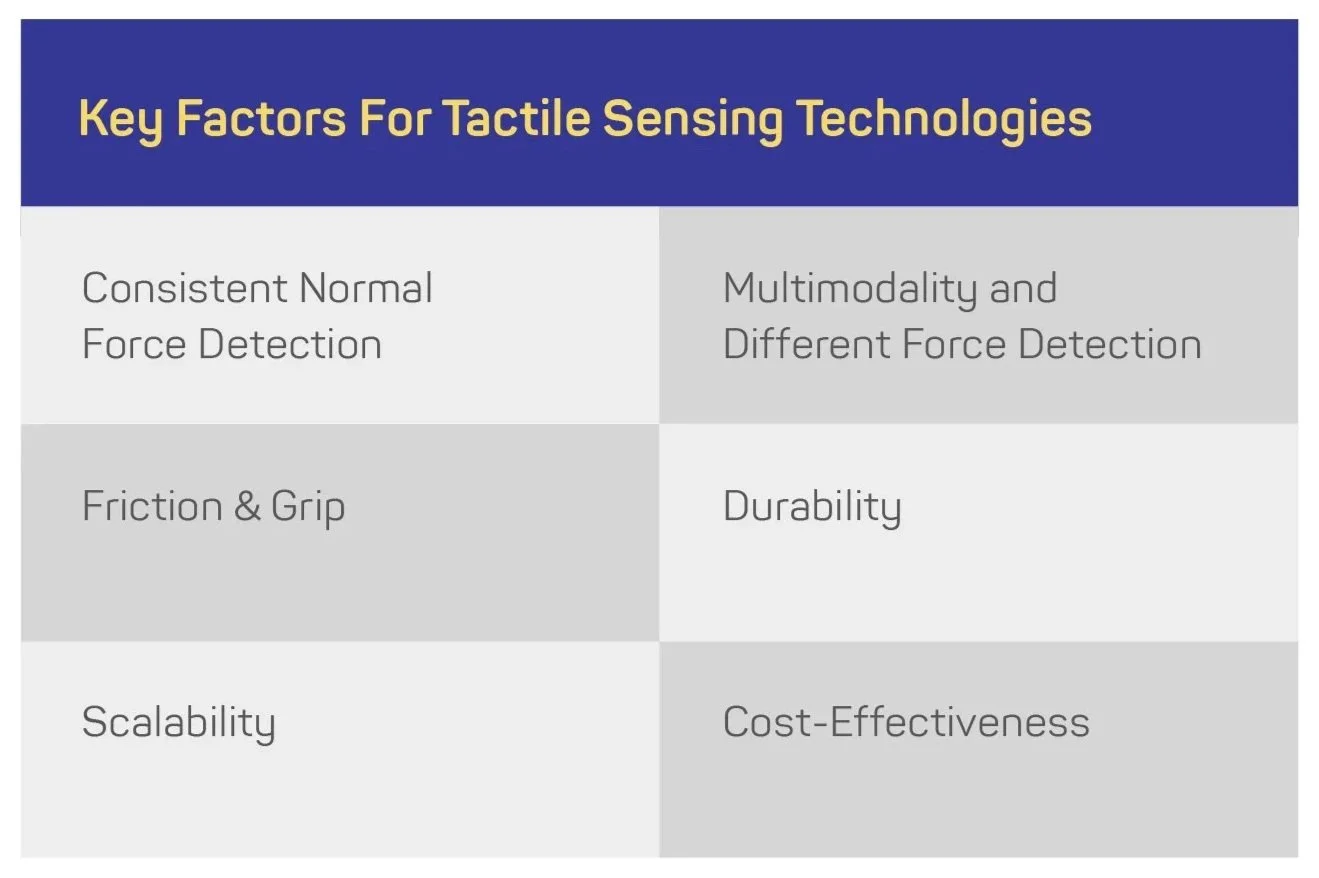
Force Mapping
One of the first qualities that defines a high-performing fingertip pressure sensor is its resolution—that is, how many distinct points the sensor can measure across its surface. The higher the resolution, the more accurately the system can map pressure distribution and subtle variations in touch.
A single-point force sensor, for example, can only detect pressure at one location, making it low-resolution by nature. A 3×3 pressure matrix is slightly higher resolution since it provides nine points we can detect force from, creating a more detailed picture of how pressure changes across the fingertip.
Optical and camera-based sensors are inherently higher resolution because every pixel acts as an individual data point.
Piezoresistive sensors, on the other hand, face physical size limitations: the more data points that can fit into a small area, the higher the resolution. However, making piezoresistive elements extremely small is still challenging, which is why they typically offer low-to-medium resolution performance.
Across the market, high-resolution fingertip pressure sensors are in growing demand as robotics and prosthetics applications require increasingly human-like touch feedback. However, low-resolution tactile sensors are often sufficient for training and dexterity improvement.
2. Multimodality and Different Force Detection
Another important factor in tactile sensor performance is multimodality, which refers to the ability to detect various types of forces. This includes normal, shear, angled, rotational, and twisting forces.
Optical sensors are already capable of measuring multiple force types, while piezoresistive sensors are still developing in this area. Engineering teams have been experimenting with sponge-like or layered structures to help these sensors gain dimensionality and better detect complex force patterns.
Among all these modes, shear detection has become one of the most critical requirements. Companies describe it as non-negotiable because it allows systems to detect when an object begins to slip, which is a key capability for any robotic application that relies on precise, controlled touch.
3. Friction & Grip
An effective fingertip pressure sensor must provide a non-slippery contact surface so that tactile readings remain accurate and reliable. In practice, this means choosing or engineering a sensor cover material with high friction. For example, optical sensors often incorporate silicone cavities or spacing to enhance grip, while piezoresistive sensors might use thermoplastic polyurethane (TPU) or other textured elastomers to increase surface friction. Maintaining a good grip ensures that the sensor surface doesn’t slide across an object during contact, which would otherwise distort pressure data and reduce the reliability of force-mapping and slip detection.
4. Durability
Durability is a must-have for sensors destined for real-world applications, especially when they are deployed long-term in robotics, prosthetics, or other applications. A high-performance fingertip pressure sensor must be able to withstand repeated stress, bending, shear loadings, and contact cycles without degradation in performance.
5. Scalability
If you’re designing a fingertip pressure sensor for multifinger robotic hands or for any widespread use, scalability becomes a key design requirement. Scalability means the sensor technology must support efficient manufacture in quantity, predictable yields, consistent performance across units, and integration into different form factors.
6. Cost-Effectiveness
Cost is often the limiting factor when deploying fingertip pressure sensors at scale. For example, in a robotic application, you might need sensors on each finger (let’s say 10 or more sensors per robot). If each sensor costs thousands of dollars, the cost of tactile sensing alone becomes prohibitive. Therefore, an ideal sensor design is cost-effective, delivering high performance at a manageable price point.
This video is an example of fingertip pressure sensors collecting grasp data:
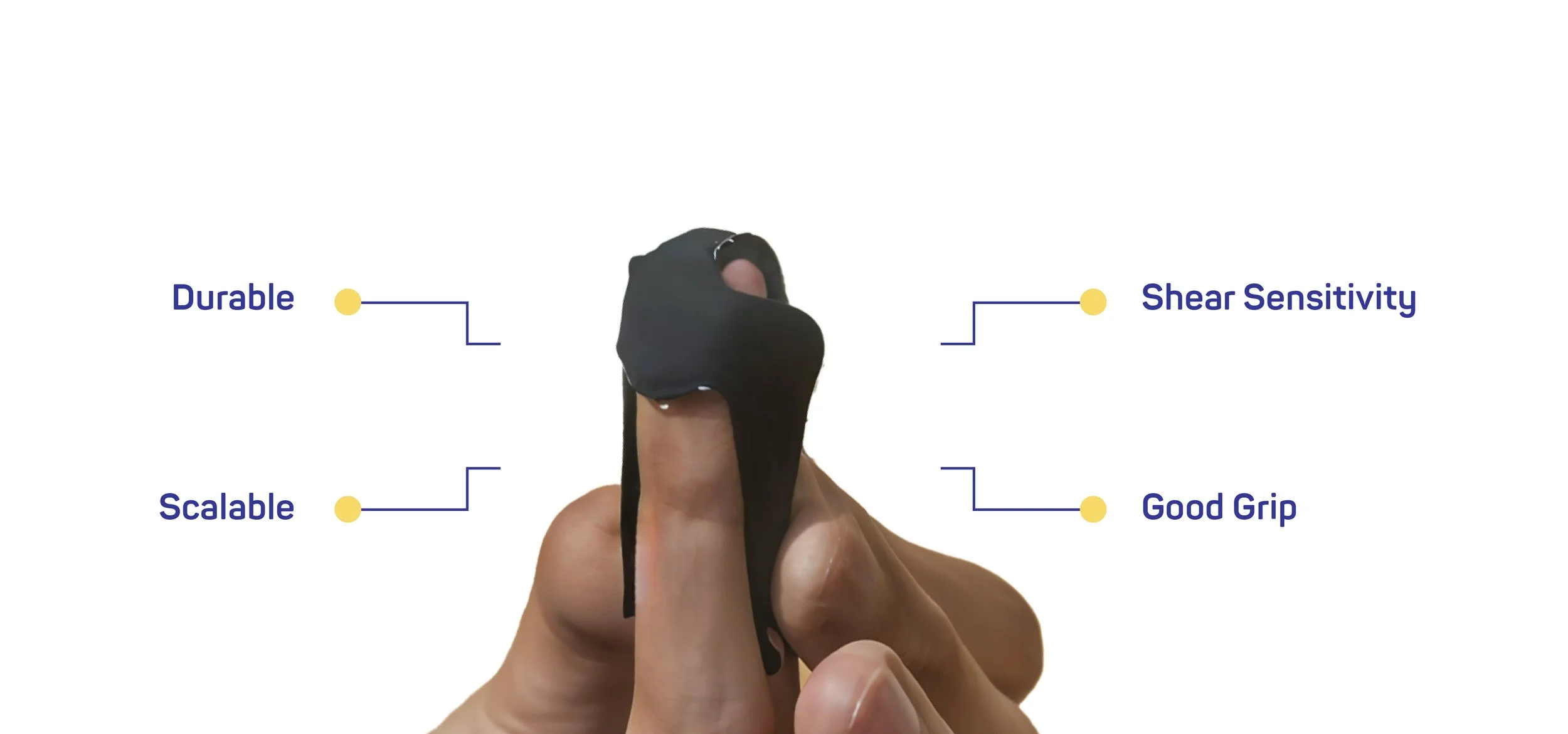
In summary, fingertip tactile sensors can be evaluated across many parameters. Many real-world robotic applications require a more balanced combination of these parameters: sensors that can survive repeated use, provide reliable grip, detect shear, and be manufactured at scale.
At Loomia, we prioritize durability, manufacturability, cost-effectiveness, strong grip interfaces, and robust shear detection, which are the features that enable a tactile system to succeed outside the lab. You can also find our new FSR collection in the Loomia Samples Shop.
What other feature sets will win in this growing and exciting market? Only time will tell! To learn more about our tactile sensing solutions, visit our tactile sensing page!
Contact our team to find the right solution.